Note
I’m not trying to improve this game’s codebase. I left it as-is as a reference point for my programming skills.
Mining the periodic table
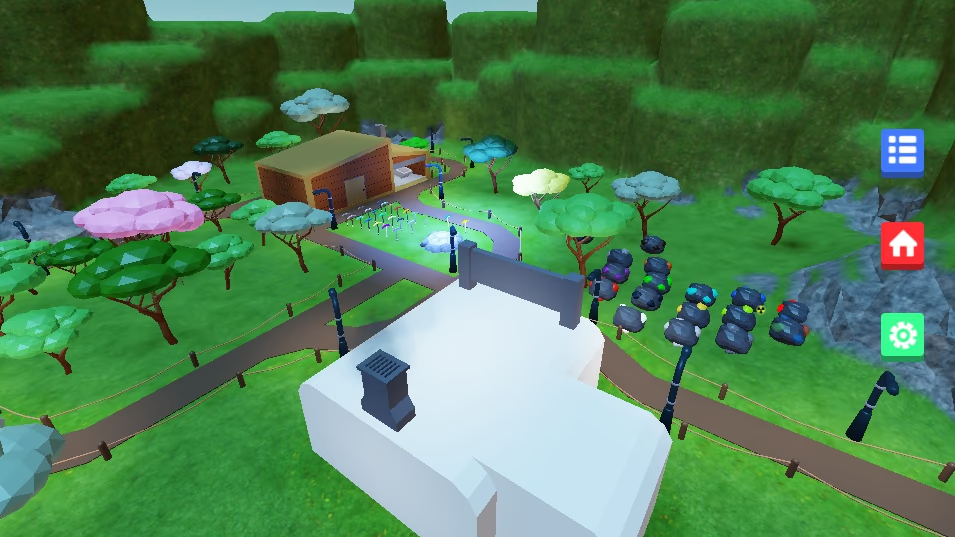
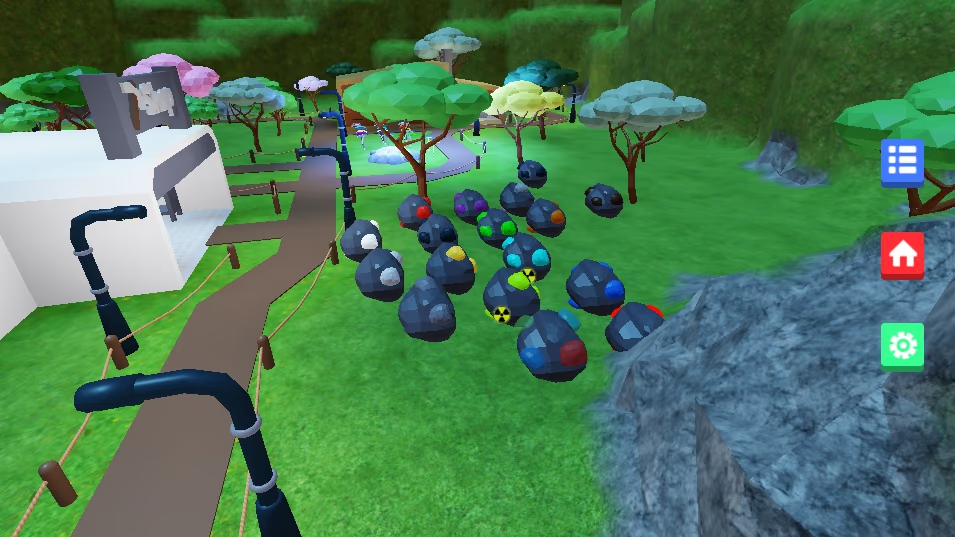
Mineros Químicos (“Chemical Miners”) is a Roblox game I started in 2021, back when I was just learning to program. You break rocks, pick up the pieces and learn a bit of chemistry on the way, because every ore was going to have a card with the element’s real data. I never finished it. What’s left is a map with 16 ore rocks, 23 pickaxes, an inventory and the card for a single element, carbon. The game is in Spanish.
The fun part
The pickaxes go from stone, which is free, to uranium, which costs 35,000. Each one has its own damage, time between swings and reach, and you can feel the difference: a copper rock takes 70 hits with the stone pickaxe and 10 with the uranium one. I named them after the chemistry, so the ruby pickaxe is the “Aluminium Oxides Pickaxe”, the emerald one is the “Beryllium Compounds Pickaxe” and the diamond one is just the “Carbon Pickaxe”. The expensive ones get an extra word in the name: the neodymium one is magnetic, and the plutonium and uranium ones are radioactive.
While you mine, a bar shows the ore’s name and how much of it is left, and every hit sounds a little different because the pitch of the sound changes at random. When the rock breaks it drops a few pieces of the same ore, each a different size, and you pick them up with Q.
The inventory opens with E and blurs the background. It has 30 slots that hold up to 999 each, and every slot shows the ore’s 3D model spinning. Click one and its card opens: name, class, symbol, crystal structure, atomic number, atomic mass, density, and melting and boiling points. The only card that’s filled in is carbon’s (C, nonmetal, atomic number 6, mass 12.01, hexagonal structure). Boron was next in line, and its card still has the letter “a” in every field.
What never got done
The pickaxes have prices, but I never wrote the shop to buy them. There’s a money counter and an ore counter that are saved between sessions, although nothing makes them go up. The code is what you’d expect from someone starting out: each of the 23 pickaxes carries its own copy of the same script, and the server believes whatever the client tells it. I still keep it around because it shows me where I started.